Last Updated on April 17, 2026 by Galaxy World
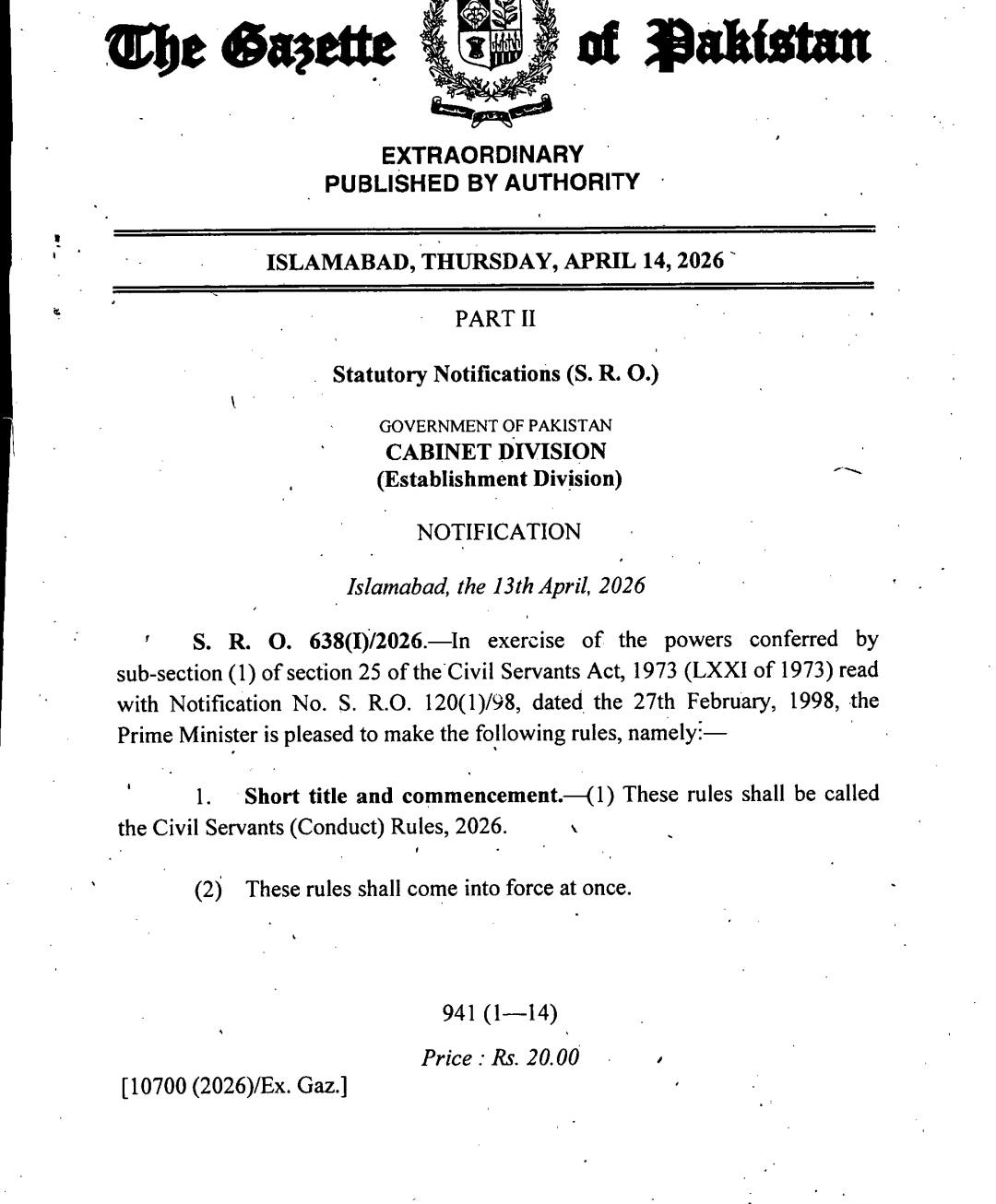
The Government of Pakistan issued the Notification in connection with the Civil Servants Conduct Rules 2026, which was released on April 14th, 2026. In light of the latest rules, these guidelines aim to establish clearer conduct standards for all civil servants.
Latest Civil Servants Conduct Rules 2026
- Date: April 14, 2026
- Location: Islamabad, Pakistan
S. R. O. 638(I)/2026.—In exercise of the powers conferred by sub-section (1) of section 25 of the Civil Servants Act, 1973 (LXXI of 1973) read with Notification No. S. R.O. 120(1)/98, dated the 27th February, 1998, the Prime Minister is pleased to make the following rules, namely:
Short Title and Commencement.—
- These rules shall be called the Civil Servants (Conduct) Rules, 2026.
- These rules shall come into force at once.
Part II
-
Extent of Application.—These rules shall apply to every civil servant, whether on duty or on leave, within or outside Pakistan, or on deputation with any other Government, agency, institution, or authority:
Provided that where empowered, the Federal Government may give directions, subject to law, to extend the application of all or any of these rules to autonomous bodies, constitutional bodies, regulatory bodies, state-owned enterprises, companies and corporations owned and controlled by the Federal Government, universities and educational institutions, and any other body established under the authority of the Federal Government and to any class of government employees. In case of such a direction, or where an entity has voluntarily adopted these rules, the expression “civil servant” shall for the purposes of these rules, be construed to be an employee of the concerned entity.
Definitions.
- In these rules, unless there is anything repugnant in the subject or context—
- “Government” means the Federal Government and in respect of officers of an All-Pakistan Service or a Federal Civil Service serving in a Province, the Provincial Government or the Federal Government, as the case may be;
- “civil servant” means a person as defined in the Civil Servants Act, 1973 (LXXI of 1973);
“member of a civil servant’s family” includes: - his spouse;
- child (whether biological or adopted), step-child, or other relatives who are financially dependent on the civil servant.
- Cadre Administrator” means a person or authority including Secretary of a Ministry or Division, Head of an Attached Department or Subordinate Office or Chairman or Chief Executive Officer or Managing Director or Board in case of any statutory or autonomous body, whose office the powers to administer a cadre or service or group of civil servants vests;
- Conflict of Interest” means a set of circumstances whereby a civil servant is in a position where his private or personal interest, or of any of the members of his family, is in conflict with, or can reasonably be perceived to be in conflict with his official obligations; and
Part II
- The Gazette of Pakistan, Extra., April 14, 2026 941(3)
- “Gift” includes non-perishable items received by a civil servant or a member of his family.
Gifts.
- No civil servant shall accept, or permit any member of his family to accept, any gift from any person, company, organization, foreign government, diplomat, consular, or other foreign government representative:
- Provided that gifts received by a civil servant or a member of his family as a member of an official delegation shall be regulated strictly in accordance with the provisions of the Toshakhana (Management and Regulation) Act, 2024.
- All offers of hospitality inside Pakistan or outside the country from any person or private company, which places a civil servant into obligation prejudicial to his official duty, shall not be accepted. In case of any doubt, the matter shall be referred to the Cadre Administrator and, in the case of the Cadre Administrator, to the Prime Minister, whose decision on whether or not to accept the offer shall be final.
- No civil servant shall give, offer, or cause to be given any gift, present, or item of value to a superior officer where such an act is, or may reasonably be perceived to be, connected to the superior officer’s official role, or intended to secure a favour, benefit, or preferential treatment, presently or potentially.
Acceptance of Foreign Awards.
No civil servant shall accept any foreign title, honour, or decoration conferred by a foreign state except with the prior approval of the Federal Government.
Public Functions in Personal Honour.—
No civil servant shall encourage, permit, or associate himself with any gathering, meeting, or event held predominantly for his projection in public or praise and acclaim in his honour, howsoever true and correct in fact and circumstance, except that a Head of a Pakistan Mission may attend a public meeting or gathering held in his honour in an official capacity while posted abroad.
Engagements Outside Official Duties (Prohibitions).
No civil servant shall—
- accept or undertake any employment, engagement, or assignment with a foreign government;
- assume full-time or part-time employment with any bank, company, private trust, foundation, not-for-profit organization or similar entity while in service, except during sanctioned Extraordinary Leave, subject to rule 10; and
- use official position, authority, or influence to solicit funds, secure votes in any electoral process other than allowed by these Rules or in connection with his official position, obtain support for or otherwise advance any private, personal, or organizational interest not connected with his official responsibility.
8. Engagements Outside Official Duties (With Prior Approval of the Cadre Administrator).
- A civil servant may, with prior written permission of the Cadre Administrator—
- take part in the raising of funds for any public or charitable purpose, provided that such funds are collected and expended by a non-profit organization duly registered in Pakistan, and that the civil servant is not involved in the direct handling of funds except as permitted under sub-rule (2);
- participate in fund-raising connected with the name of another civil servant or a person who has recently quitted government service, provided that the civil servant concerned has no personal relationship with such civil servant or person;
- promote, register, or take part in the management of a bank, company whether public or private limited, trust, foundation, not-for-profit organization, cooperative society, or academic institution, provided that such participation does not amount to full-time employment;
- undertake private work, including teaching, consultancy, or other professional activities, provided that no conflict of interest arises, and that the official duties are not affected at all:
- Provided that, one twenty-fifth of the remuneration thus received by the civil servant shall be deposited in the Treasury, the receipt of which shall be duly presented to the Cadre Administrator annually.
- Where a civil servant is permitted to take part in fund-raising activities on any count under this rule and receives or holds any funds, he shall maintain proper accounts and submit the same to the next higher officer for information, and for scrutiny, should the higher officer desire so.
9. Engagements Outside Official Duties (Without Prior Permission).
- A civil servant may, without prior permission…
Undertake Honorary Work of a Religious, Social or Charitable Nature, or Occasional Work of a Literary, Academic or Artistic Character, Subject to the Conditions That—
- His official duties do not thereby suffer; and
- Such undertaking does not conflict with or is not inconsistent with his position or obligations as a civil servant.
He shall not undertake or shall discontinue such undertaking, if so directed by a superior officer. A civil servant, who has reasons to disagree with such directions, may refer the matter for the orders of the Cadre Administrator; and
A Non-Gazetted Civil Servant May Operate or Participate in a Small Family Enterprise Absorbing Family Labour, Subject to Declaration of Such Enterprise in the Declaration of Assets Under Rule 12.
Employment During Extraordinary Leave.
- A civil servant may, during sanctioned Extraordinary Leave, accept full-time employment with a bank, company, trust, foundation, not-for-profit organization, or academic institution, whether public or private, subject to the condition that—
- Such employment is duly approved by the Cadre Administrator.
- The employment does not relate to the areas of security or defence or to areas, sectors, services, or industries about positions held by him during the last five years; and
- Upon rejoining Government service, the civil servant shall submit a conflict of interest declaration, undertaking not to participate in any decision or matter directly or purportedly benefiting his former employer organization for a period of three years and that he shall recuse himself from such matters to avoid any real or potential conflict of interest.
11. Lending and Borrowing.
- No civil servant shall lend money to, or borrow money from, or place himself under any pecuniary obligation to any person falling within the limits of his official authority or any person with whom he has any official dealings:
- Provided that the above rule shall not apply to dealings in the ordinary course of business with a joint stock company, bank, or a firm of standing.
- When a civil servant is appointed or transferred to a post of such a nature that a person from whom he has borrowed money or to whom he has otherwise placed himself under a pecuniary obligation, shall be subject to his official authority, or shall reside, possess immovable property, or carry on business within the local limits of such authority, he shall forthwith declare the circumstances to the Cadre Administrator through the usual channel.
- Non-gazetted civil servants shall make the declaration referred to in sub-rule (2) to the head of their office.
- This rule, in so far as it may be construed to relate to loans given to or taken from cooperative societies registered under the Cooperative Societies Act, 1912 (II of 1912), or under any law for the time being in force relating to the registration of Cooperative Societies, by the civil servants, shall be subject to any general or special restrictions or relaxations made or permitted by the Government.
12. Declaration of Assets.—
- Every civil servant shall, at the time of entry into service, make a declaration (hereinafter called the first declaration) to the Cadre Administrator, through proper channel, as to details of all immovable and movable properties including shares, bank accounts, virtual assets, certificates, securities, insurance policies, and jewelry if the latter’s total worth is rupees five million or more, belonging to or held by him or a member of his family in the Asset Declaration Form specified by the Establishment Division.
- The civil servant shall also give such further information pertaining to his assets as the Cadre Administrator may, by a general or special order, require.
- Subsequent to submission of the first declaration under sub-rule (1), every civil servant shall submit to the Cadre Administrator, through proper channel an annual declaration of income, assets, and expenses for each financial year (1st July to 30th June), hereinafter referred to as the declaration, showing any increase or decrease of assets as shown in the first declaration under sub-rule (1) or the last declaration, as the case may be, in the manner and form specified by Establishment Division.
- The first declaration filed pursuant to sub-rule (1) and declaration filed under sub-rule (3) shall be opened in the concerned section each year and entered into the relevant database in the month of December showing any increase or decrease of property from the first declaration under sub-rule (1), or the declaration under sub-rule (3).
- The declaration filed by the civil servants BPS-01 to BPS-16 shall continue to be filed manually in an Assets Declaration Form until the Establishment Division notifies a date for the digital filing of these forms in a specified manner.
- Effective from a date to be notified by the Establishment Division, every civil servant of BPS-17 and above shall digitally file the declaration for a financial year (1st July to 30th June) on an online portal in a manner specified by the Establishment Division, by 30th October of the following financial year:
- Provided that a civil servant may, in case of any mistake in making the declaration, having cited cogent reasons, with the approval of the Cadre Administrator, submit a correction and have any particular entry corrected, by the following 30th November.
- Asset Declarations by government servants of BPS-17 or equivalent and above, other than the civil servants, shall continue to be filed as per sub-rule (3) above, until adoption of digital filing by their respective organizations or directions by the Federal Government.
- The digitally-filed declarations shall be subjected to risk-based verification undertaken by the Federal Board of Revenue (FBR) as per a framework agreed upon between the Establishment Division and the FBR, the results of which shall be shared with the respective Cadre Administrators.
- A civil servant shall be liable to explain any omission, mis-declaration or unexplained or undeclared increase in assets identified as a result of the risk-based verification or any other verification exercise to the satisfaction of the Cadre Administrator, who shall determine whether any declaration, omission to declare, mis-declaration or any change in state of assets or expenses etc., is substantive and material and whether it warrants any further inquiry by way of a notice, explanation, departmental proceedings or investigation, and shall proceed accordingly.
- The Declarations submitted under sub-rule (6) shall be publicly disclosed with restrictions and necessary redactions as to confidential personal information in the manner specified by the Establishment Division.
13. Conflict of Interest.—
- No civil servant shall, in the exercise of his official duties, place himself in a position where his private or personal interests, or of any of the members of his family, conflict or could reasonably be perceived to be in conflict with his official duties.
- In any instance of a conflict of interest, the civil servant, as an incumbent of any office or as a member of a decision-making body, including a selection or procurement committee, having declared his conflict of interest, shall recuse from the proceedings as soon as he is cognizant of any such conflict. In case he is the final approving or decision-making authority, he shall refer the matter to the next higher authority for further guidance and orders.
- No civil servant shall influence, or attempt to influence, his subordinates directly or indirectly for matters relating to his personal interests.
- Where a civil servant or a member of his immediate family intends to make an investment that may potentially give rise to a conflict of interest, prior written disclosure shall be made to the Cadre Administrator; and in case the Cadre Administrator prefers to pass any orders in this respect, these shall be final and binding on the civil servant concerned.
Civil Servant Not to Live Beyond Means, Etc.
- It shall not be acceptable for a civil servant to live beyond his ostensible or declared means of living. Likewise, he is not expected to indulge in ostentatiousness and extravagance in social gatherings hosted by him or his spouse, by way of incurring expenditure not in consonance with their ostensible or declared means of living.
- In case where a civil servant is cognizant of the fact that a social gathering to be hosted, or already hosted by him or his spouse is going to be, or was prima facie ostentatious, extravagant or not in consonance with his ostensible or declared means of living, he shall immediately report as to the expenses going to be undertaken or already undertaken on that particular ceremony and the sources of funds thus to be or already expended.
- A Cadre Administrator may, at any time, require a civil servant to submit information about the expenses undertaken on a social gathering as explained in sub-rule (1) and the sources thereof.
Intimation of Involvement and Conviction in a Criminal Case.
- If a civil servant is involved, as an accused in a criminal case, he shall forthwith bring the fact of such involvement or conviction in that case, irrespective of whether an appeal lies against the court’s order or not, or if he is arrested and whether or not released on bail, to the notice of his Cadre Administrator.
16. Unauthorized Communication of Official Documents or Information.—
- No civil servant shall, except in accordance with any permission accorded by the Head of the Office or the Secretary of the Division concerned, communicate directly or indirectly, any official document or information to any person not authorized to receive it.
- A civil servant shall not, or seek to, frustrate the policies, decisions or actions of the Government by way of unauthorized, improper or premature disclosure made to anyone outside the Government, of any information to which he has or had access as a civil servant in connection with his official responsibilities, directly or indirectly.
17. Management and Use of Media Platforms.—
- Civil Servants and Digital Content Participation:
- No civil servant shall, except with prior sanction from the Cadre Administrator, own wholly or in part, or conduct/manage:
- Content writing, editing, or management of any website, web page, portal, content-streaming platform (video/audio blogging, vlogging, podcasting), content-sharing or messaging service, television or radio broadcast, or printed media (newspaper/periodical), whether by name, anonymously, or pseudonymously.
- Exception: Content shared from a personal account on digital or social media platforms that is visible only to a limited and defined group of individuals (not the public at large) does not fall under this rule.
- No civil servant shall, except with prior sanction from the Cadre Administrator, own wholly or in part, or conduct/manage:
- Disciplinary Action for Anonymous Content:
- If a civil servant publishes, circulates, or shares material via an anonymous or pseudonymous account that discredits, embarrasses, or undermines the Government or its institutions, they will be liable to disciplinary proceedings under applicable rules.
- Official Social Media Accounts:
- Official social media accounts can only be created and operated with the prior permission of the supervising officer.
- These accounts must be used exclusively for communicating verified official information, institutional activities, and matters related to the functions of the office.
- Content that distorts, misrepresents, or affects the Government’s reputation negatively is prohibited.
- Upon transfer of charge, outgoing officers must hand over all login credentials, archival data, and administrative rights to their successors.
- Official accounts should not be used for personal publicity, branding, lifestyle projection, or unrelated content.
- Personal Social Media Accounts:
- Civil servants must keep personal social media accounts distinct from official accounts.
- No content depicting official work, responsibilities, functions, government resources, or any official matters should be posted for personal benefit, publicity, or image building.
- A Cadre Administrator may require civil servants to declare their personal social media accounts (public or private) by special order.
- Personal Memoirs:
- A civil servant shall not publish or broadcast personal memoirs reflecting experiences from their service if the content involves disclosure of confidential information.
- Propagation of Sectarian Creeds:
- No civil servant shall propagate sectarian creeds, engage in sectarian or ethnic controversies, or indulge in biases or favouritism based on ethnicity, sect, religion, etc., that could affect their impartiality, discredit the administration, or cause discontent among civil servants or the public.
- Civil Servant Not to Express Views, Against the Ideology of Pakistan:
- No civil servant shall express views detrimental to the ideology or integrity of Pakistan.
- Civil Servant Not to Take Part in or Assist Any Public Demonstration:
- No civil servant shall take part in, or in any manner assist, any public demonstration directed against a Government decision or policy.
- Nepotism, Favouritism and Victimization, Etc.:
- No civil servant shall indulge in:
- Nepotism, provincialism, tribalism, biradari-ism, or favouritism based on service, group, cadre, gender, race, religion, caste, residence, or place of birth.
- No civil servant shall indulge in:
- Vindication by Civil Servants of Their Public Acts or Character:
- (1) Except in cases where disciplinary proceedings or criminal proceedings are instituted by the Government, a civil servant may seek recourse to any court or the press for the vindication of his public acts in good faith or character from defamatory attacks under intimation to the Cadre Administrator.
- The Government shall ordinarily reimburse part or all of the court proceedings cost within prescribed financial limits if the civil servant wins the defamation suit or is acquitted of criminal proceedings.
- (2) This rule does not affect a civil servant’s right to vindicate private acts or character.
- (1) Except in cases where disciplinary proceedings or criminal proceedings are instituted by the Government, a civil servant may seek recourse to any court or the press for the vindication of his public acts in good faith or character from defamatory attacks under intimation to the Cadre Administrator.
- Membership of Service Associations:
- No civil servant shall be a member, representative, or officer of any association representing civil servants unless:
- (a) Membership is confined to a distinct class of civil servants and open to all in that class;
- (b) The association is not connected or affiliated with any association that does not meet (a);
- (c) The association is not connected with any political party or organization or engage in political activity.
- (d) The association shall not:
- Issue or maintain publications except as permitted by the Cadre Administrator.
- Publish representations without the previous sanction of the Cadre Administrator.
- (e) The association shall not:
- Contribute to any expenses incurred by a candidate for election to a legislative body or local authority.
- Support any election candidate or assist in electors’ registration or candidate selection.
- (f) The association shall not:
- Maintain or contribute towards maintaining any member of a legislative body or local authority.
- Contribute to trade union expenses.
- (g) The association shall not:
- Organize or support any illegal industrial action, protest, or agitation.
- No civil servant shall be a member, representative, or officer of any association representing civil servants unless:
- Membership of Non-Political Associations:
- No civil servant shall accept membership of any non-political association or organization whose aims, objects, nature, and membership are not publicly declared.
- Use of Political or Other Influence:
- (1) No civil servant shall attempt to bring political or extraneous influence on the Government or any civil servant in support of any claim related to employment or decisions by any authority.
- (2) No civil servant shall attempt to influence decisions in a manner that constitutes undue patronage or favouritism.
- Representation or Appeals by Civil Servants:
- No civil servant shall submit any appeal, application, or representation except through the proper channel, unless expressly permitted under law or rules.
- Approaching Foreign Missions and Other Entities for Personal Gains:
- No civil servant shall approach a foreign mission in Pakistan, a foreign donor or lending agency, or a corporate entity for invitations or training opportunities abroad.
- Behaviour, Conduct and Attitude Becoming of a Civil Servant:
- A civil servant shall maintain a reasonable standard of conduct, behaviour, and attitude, including:
- Responsibility, dealings with other civil servants, public representatives, and the public.
- Punctuality, attention to duty, appropriate turn out, and maintaining public image.
- These standards apply to both personal and official social media accounts.
- A civil servant shall maintain a reasonable standard of conduct, behaviour, and attitude, including:
- Avoidance of Frivolous, Baseless, and Wasteful Complaints:
- A civil servant shall not make frivolous or baseless complaints against other civil servants leading to waste of time and resources.
- The Cadre Administrator’s decision on whether a complaint is frivolous, baseless, or wasteful shall be final.
- Rules Not to Be in Derogation of Any Law, Etc.:
- Nothing in these rules shall derogate from any law relating to the conduct of civil servants currently in force.
- Violation of Civil Servants (Conduct) Rules, 2026:
- Any violation of these rules shall be considered misconduct under the Civil Servants (Efficiency and Discipline) Rules, 2020.
- Repeal of Conduct Rules:
- The Government Servants (Conduct) Rules, 1964, are repealed, but the repeal shall not affect actions already taken under the repealed rules.
Download Full Document: Download Notification of Establishment Division